Why 3D Scanning Matters Before Mining Equipment, Conveyor and Chute Upgrades
Hamilton By Design shares expert insights into mechanical engineering, 3D laser scanning, SolidWorks modelling, and industrial plant design. Focused on mining, manufacturing, and infrastructure projects, this blog explores scan-to-CAD workflows, fabrication-ready detailing, and engineering-led solutions that reduce risk, improve accuracy, and deliver real-world outcomes for clients, engineers, and fabricators across Australia.
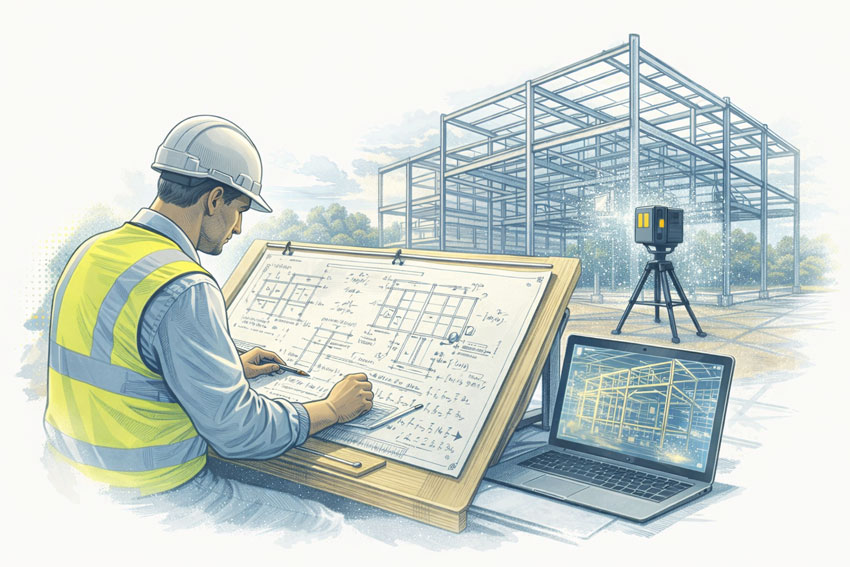
Structural Detailing for Accurate Fabrication and Easier Site Installation
At Hamilton By Design, we provide structural detailing services that help turn engineering intent into clear, buildable fabrication information. Our focus is on producing practical, accurate shop drawings and 3D models that fabricators, project managers, and site teams can actually use with confidence.
Good structural detailing does more than document steelwork. It reduces workshop questions, improves coordination, helps identify clashes earlier, and supports smoother fabrication and installation. Whether the job involves a simple support frame or more complex plant and infrastructure steelwork, the goal is always the same: deliver detailing that is clear, efficient, and ready for manufacture.
Our experience covers a wide range of structural and industrial applications, including structural steel frames, mezzanine floors, portal frames, trusses, access platforms, industrial stairs and ladders, machine support structures, canopies, lifting frames, transfer systems, and plant infrastructure. We also support projects where structural detailing needs to interface closely with mechanical equipment, conveyors, piping, and brownfield modifications.
Where required, we develop 3D CAD models to improve accuracy and coordination before drawings are issued. This can help detect interferences early, improve communication between stakeholders, and support better fabrication outcomes. For brownfield or upgrade projects, our structural detailing can also be supported by engineering-grade 3D laser scanning so that new work is developed around real site conditions rather than assumptions.
Hamilton By Design supports clients who need:
We work with clients across industrial, mining, manufacturing, and infrastructure sectors, delivering detailing that supports fabrication quality, fit-up confidence, and more efficient project execution.
To learn more, visit:
Hamilton By Design – practical structural detailing backed by real engineering experience.
Hamilton By Design knowledge centre
Explore how engineering-grade 3D scanning, point-cloud processing, Scan-to-CAD, reverse engineering and SolidWorks can support accurate design, fabrication and brownfield engineering projects.
Connect measured site conditions with engineering-ready SolidWorks modelling and verification workflows.
Read article →Learn how LiDAR data can become accurate CAD geometry for design, modification and dimensional verification.
Read article →Discover 3D CAD modelling services for machinery, industrial equipment and engineering projects across Australia.
Read article →See how measured site data and coordinated 3D models can reduce fabrication clashes, rework and installation risk.
Read article →Follow the workflow from engineering-grade LiDAR capture to structured CAD models and Australian-standard drawings.
Read article →An integrated scanning, SolidWorks and 3DEXPERIENCE workflow for Sydney port and marine engineering projects.
Read article →Convert marine and port-infrastructure point clouds into usable, engineering-ready CAD models.
Read article →Compare terrestrial, handheld and other scanner types, including their accuracy and appropriate engineering applications.
Read article →Consider what the acquisition may mean for FARO technology, measurement solutions and engineering users.
Read article →Develop dependable digital representations of existing industrial assets using measured reality and structured engineering data.
Read article →Understand the progression from site capture and registration to point-cloud processing and CAD deliverables.
Read article →Explore the controls, accuracy requirements and engineering governance behind a dependable LiDAR survey.
Read article →Learn why verified existing conditions are essential before beginning detailed design or plant modification work.
Read article →Connect reality capture, point-cloud processing and CAD modelling within a coordinated engineering workflow.
Read article →Find out where terrestrial laser scanning fits within industrial, infrastructure and as-built measurement projects.
Read article →Examine how measured physical data gives AI-assisted engineering tools reliable geometric context.
Read article →Review practical applications of engineering-grade 3D laser scanning across Australian industrial projects.
Read article →Convert registered point-cloud information into practical CAD geometry for Sydney engineering and industrial projects.
Read article →See how laser-scan data can be converted into coordinated AutoCAD drawings for engineering documentation.
Read article →Learn how verified scan data can support digital twins for plant upgrades, coordination and asset management.
Read article →Explore Hamilton By Design’s engineering-led 3D laser scanning, LiDAR, point-cloud and Scan-to-CAD services across Australian metropolitan, regional and industrial locations.
Explore additional Hamilton By Design services and engineering insights covering FARO laser scanning, point-cloud processing, SolidWorks modelling, reverse engineering, FEA and fabrication-ready CAD deliverables.
Parametric 3D modelling, mechanical design, fabrication drawings and scan-based CAD development for mining and industrial projects.
Explore this service → Mechanical DesignDevelop mechanical components, assemblies and plant equipment as accurate, editable models ready for review, manufacture and installation.
Explore this service → Engineering AnalysisConnect SolidWorks design models with stress, deflection, fatigue and mechanical verification for components and industrial equipment.
Explore FEA capabilities → 3D CAD ModellingConvert point clouds, drawings, PDFs, sketches and site measurements into practical engineering models for plant and mechanical projects.
Explore CAD modelling → Integrated EngineeringEngineer-led LiDAR scanning, CAD modelling, mechanical design, FEA and structural support delivered through a connected project workflow.
View engineering services → Reality CaptureCapture existing plant, equipment, structures and pipework for as-built documentation, design development and brownfield upgrades.
Explore 3D scanning → Engineering-Grade CaptureEngineer-planned and verified LiDAR capture developed specifically to support design, fabrication and shutdown engineering decisions.
Learn about engineering-grade LiDAR → Point-Cloud DataUse measurable point-cloud data to verify clearances, establish equipment geometry and develop accurate downstream CAD models.
Explore point-cloud scanning → Reverse EngineeringCapture existing industrial assets and reconstruct practical CAD models without automatically reproducing wear, damage or obsolete details.
Explore reverse engineering → Engineering StudiesCombine LiDAR scanning, dimensional verification and CAD modelling for equipment replacement, refurbishment and brownfield modifications.
View Scan-to-CAD studies → Scan-to-CADTransform registered laser scans into usable 2D drawings, AutoCAD information and 3D models for engineering and fabrication planning.
Explore point-cloud to CAD → Engineering InsightCompare manual site measurement with reality-capture workflows for brownfield plants, industrial facilities and complex infrastructure.
Read the comparison → Engineering DataUnderstand the difference between a mesh that represents surface shape and point-cloud information that supports real engineering decisions.
Read the engineering guide → FARO TechnologyLearn how the FARO scanning ecosystem supports industrial reality capture, engineering design and fabrication-ready project outcomes.
Explore the FARO workflow → Digital VerificationDigitally verify fabricated components, structural steel, spools and mechanical assemblies before transport and installation.
Explore digital QA → Scanning TechnologyUnderstand when terrestrial LiDAR is appropriate and when components require a closer-range, higher-detail metrology scanning method.
Compare scanning methods →