From Reality Capture to Intelligent Asset Information
Sydney's construction, infrastructure, industrial and property sectors continue to invest heavily in digital engineering, BIM workflows and accurate existing-condition information. As projects become more complex, relying on outdated drawings or incomplete documentation introduces unnecessary risk.
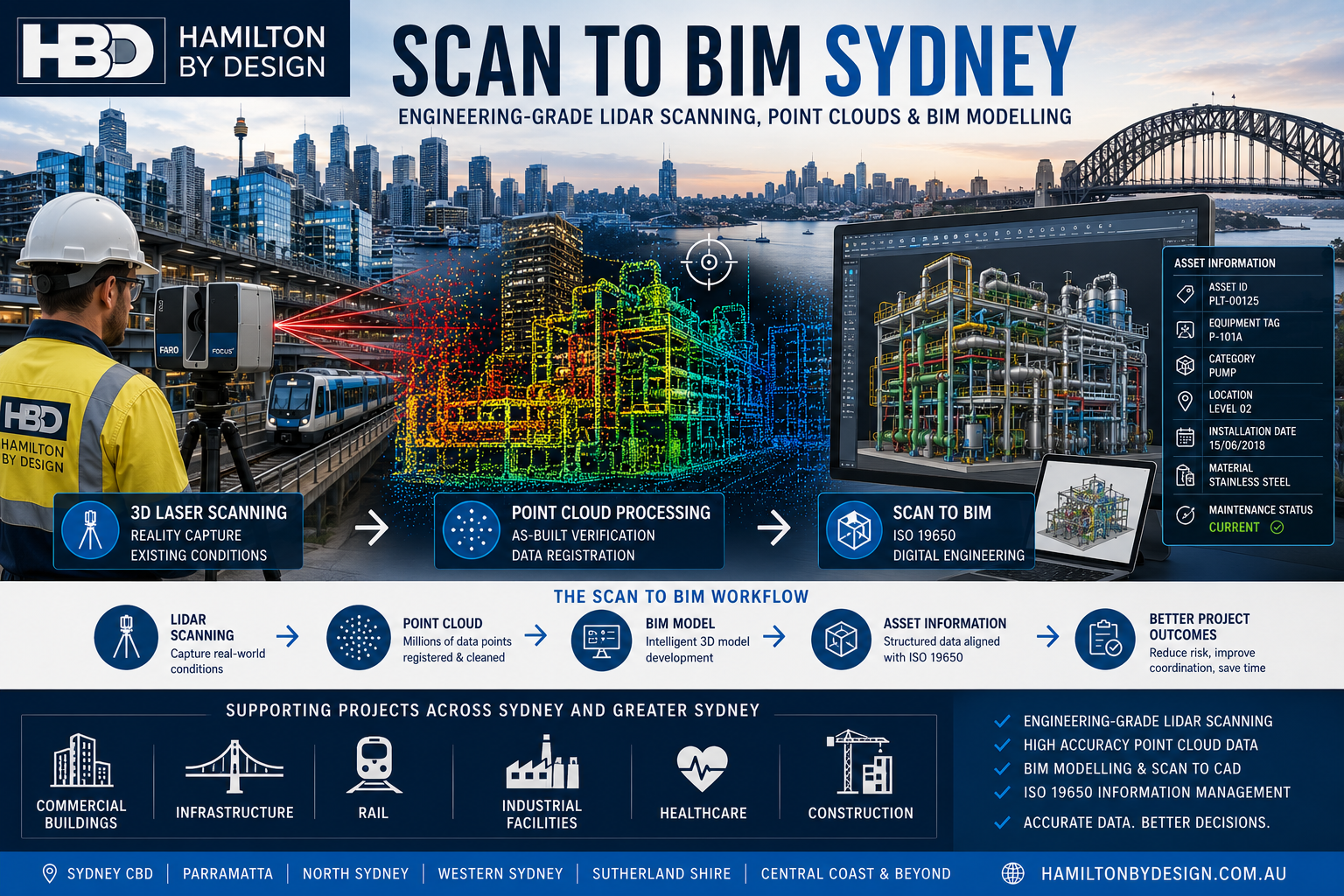
Scan to BIM Sydney combines engineering-grade LiDAR scanning, point cloud processing and Building Information Modelling (BIM) to create accurate digital representations of real-world assets. These models support design, construction, asset management and future project planning by providing a reliable digital foundation based on measured reality rather than assumptions. Scan-to-BIM workflows are increasingly used to create accurate BIM models for retrofit projects, design coordination and long-term asset management. (Hamilton By Design Co.)
What is Scan to BIM?
Scan to BIM is the process of capturing existing buildings, infrastructure and industrial facilities using high-accuracy laser scanning technology and converting the resulting point cloud data into intelligent BIM models.
The workflow typically includes:
The result is an accurate digital representation of the physical asset that can be used throughout the project lifecycle.
Why Sydney Projects Use Scan to BIM
Sydney contains a diverse mix of commercial buildings, rail infrastructure, industrial facilities, hospitals, universities and brownfield sites. In many cases, original drawings no longer reflect actual site conditions.
Scan to BIM helps project teams:
Improve Accuracy
Millions of measured points are captured directly from site conditions, creating a reliable digital record that supports engineering and construction decisions. Engineering-grade LiDAR scanning provides measurable geometry suitable for BIM coordination and as-built verification. (Hamilton By Design Co.)
Reduce Rework
Accurate digital models help identify clashes, access constraints and design conflicts before fabrication or installation begins.
Improve Collaboration
Architects, engineers, contractors and asset owners can work from a common source of information throughout the project.
Support Asset Management
BIM models become a long-term information resource that can support maintenance, future modifications and operational planning.
Applications of Scan to BIM Across Sydney
Hamilton By Design supports projects throughout Sydney and Greater Sydney, including:
Commercial Buildings
Office towers
Retail centres
Mixed-use developments
Building refurbishments
Property portfolios
Infrastructure
Industrial Facilities
Healthcare & Education
Hospitals
Universities
Schools
Research facilities
Brownfield Upgrades
Many Sydney projects involve modifications to existing assets where accurate existing-condition information is essential for project success. Engineering-led scanning supports brownfield upgrades, equipment replacement projects and shutdown planning where accuracy directly impacts project outcomes. (Hamilton By Design Co.)
Engineering-Led Scan to BIM
A successful Scan to BIM project is not simply about producing a 3D model.
Engineering considerations include:
Hamilton By Design applies engineering knowledge throughout the workflow to ensure the final BIM model supports design, construction and operational objectives.
Scan to BIM and ISO 19650
Modern BIM projects increasingly require structured information management.
ISO 19650 provides an internationally recognised framework for organising and managing information across the entire asset lifecycle.
When Scan to BIM workflows are aligned with ISO 19650 principles, project teams benefit from:
For more information:
👉 ISO 19650, Scan to BIM and Information Management
Academic Perspective on Scan to BIM
As reality capture technologies continue to evolve, organisations are increasingly investigating how Scan to BIM can support digital twins, AI-assisted modelling and automated asset information management. Hamilton By Design has explored these topics through a detailed academic review of Scan to BIM technologies and industry adoption.
👉 Scan to BIM Academic Review
Typical Scan to BIM Workflow
1. Site Capture
Engineering-grade LiDAR scanners capture millions of measurements across the project area.
2. Point Cloud Registration
Individual scans are aligned and combined into a registered point cloud dataset.
3. Point Cloud Processing
Data is reviewed, cleaned and validated against project requirements.
4. BIM Model Development
The point cloud is converted into BIM geometry and structured asset information.
5. Quality Assurance
Models are checked against accuracy requirements and project specifications.
6. Information Delivery
Final deliverables are provided in formats suitable for BIM, CAD and asset management workflows.
Deliverables
Typical Scan to BIM deliverables include:
These deliverables support design coordination, construction planning, retrofit engineering and long-term asset management. (Hamilton By Design Co.)
Scan to BIM Sydney Coverage
Hamilton By Design supports projects throughout:
Sydney CBD
Parramatta
North Sydney
Chatswood
Liverpool
Penrith
Western Sydney
Sutherland Shire
Newcastle
Hunter Valley
Central Coast
Why Choose Hamilton By Design?
Hamilton By Design combines practical engineering experience with advanced reality capture technologies.
We understand how scan data is used throughout engineering workflows and deliver information that supports:
Design development
BIM coordination
Construction planning
Asset management
Mechanical engineering
Structural engineering
Infrastructure projects
Rather than simply collecting data, we focus on delivering information that engineers, project managers and asset owners can use with confidence.
Need a Scan to BIM Sydney Quote?
Whether you are upgrading an industrial facility, documenting existing conditions, creating an as-built BIM model or implementing ISO 19650 information management workflows, Hamilton By Design can help.
Engineering-Grade LiDAR Scanning. Accurate Point Clouds. Reliable BIM Models.
Accurate Data. Better Design. Safer Construction. Smarter Asset Management.